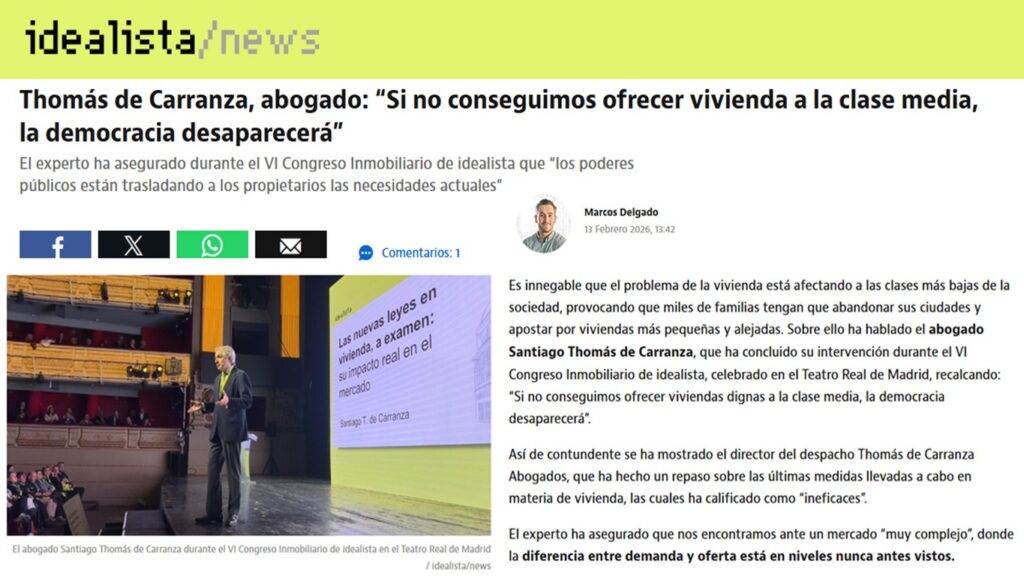
Santiago Thomás de Carranza, managing partner of the firm, has analyzed the effects of the new housing laws in Spain during his speech at the VI Real Estate Congress of Idealista. Held at the Teatro Real, the meeting was attended by more than 1,000 clients of the real estate platform.
In his speech, Thomás de Carranza emphasized the social impact of the housing problem and the need to address structural reforms from a “technical and not ideological approach”. In addition, he stressed that “the difficulty of access to housing is directly affecting the middle classes and the most vulnerable groups, forcing thousands of families to leave urban centers and opt for smaller and more remote homes”. In this context, he warned: “If we fail to provide decent housing for the middle class, democracy will disappear”.
The expert has described as “ineffective” the measures adopted in recent years regarding housing and describes the current scenario as a “very complex” market, marked by a historical imbalance between supply and demand. In this regard, he recalled that Spain will reach 49.5 million inhabitants this year and that, according to the Bank of Spain, there is a deficit of approximately 700,000 homes, while the rate of construction is around 100,000 units per year, creating a scenario of high tension.
Another focus of his speech was the lack of legal certainty in the rental market. Thomás de Carranza pointed out that current policies “are protecting squatting and applying burdens on homeowners”, adding that “the public authorities are transferring current needs to homeowners”. In his opinion, “this approach erodes the confidence of owners and ultimately results in higher prices and higher access requirements”.
Along these lines, he defended the need to implement measures that clearly reject squatting and reinforce the protection of property rights, with the aim of recovering security and predictability in the market. “The higher the risk of default, the higher the prices and requirements; that’s how markets work,” he remarked.
During his speech, the lawyer also recalled that the rate of effort in both renting and buying already exceeds the 30% recommended by experts, and that in large cities such as Madrid, Barcelona, Malaga and Valencia it is above 40%. For this reason, he urged political leaders to “put aside their ideology, sit down with experts in the sector and carry out a great State Pact for housing, because it is as important as health or education”.
Thomás de Carranza has mentioned the Catalan model as an example of the adverse effects of interventionist policies. In his opinion, the price cap has not solved the problem and has led to a drop in supply. He recalled that, while in Spain there are more than 110 people interested in each rental property, in Barcelona the figure rises to 350. In addition, he pointed out that the declaration of more than 200 municipalities as stressed areas has pushed many owners towards modalities such as seasonal or room rentals.
The managing partner of the Firm has also pointed out that there is something that has changed, referring to social tolerance towards squatting. In reference to the extension of the “social shield”, which paralyzes evictions until December 31, 2026, he highlighted as a positive point the fact that it seeks to alleviate the burden borne by small property owners and stressed that “property owners cannot carry the social needs and responsibilities of the State”.
As lines of action, Thomás de Carranza is committed to decisively increasing the public housing stock -which in Spain barely reaches 3% of the total-, promoting public-private collaboration, freeing up land and speeding up urban development procedures. “We must protect property owners, encourage private collaboration, free up land and, especially, streamline the endless urban planning procedures,” he concluded.
Read the Idealista article: https://www.idealista.com/news/inmobiliario/vivienda/2026/02/13/884388-thomas-de-carranza-abogado-si-no-conseguimos-ofrecer-vivienda-a-la-clase-media-la