- Mandatory extensions, limits on rent increases, and changes to rental regulations, among other issues
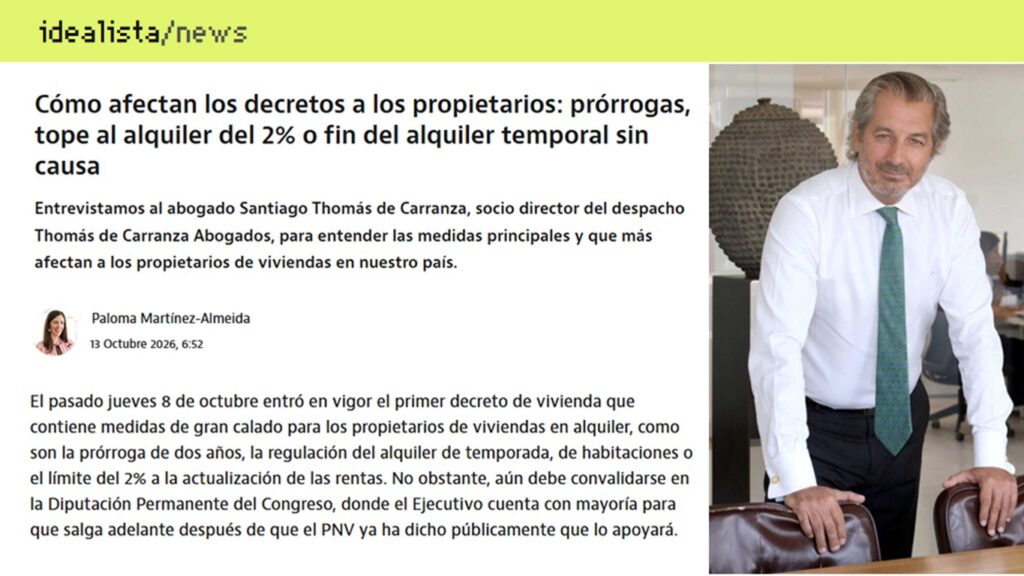
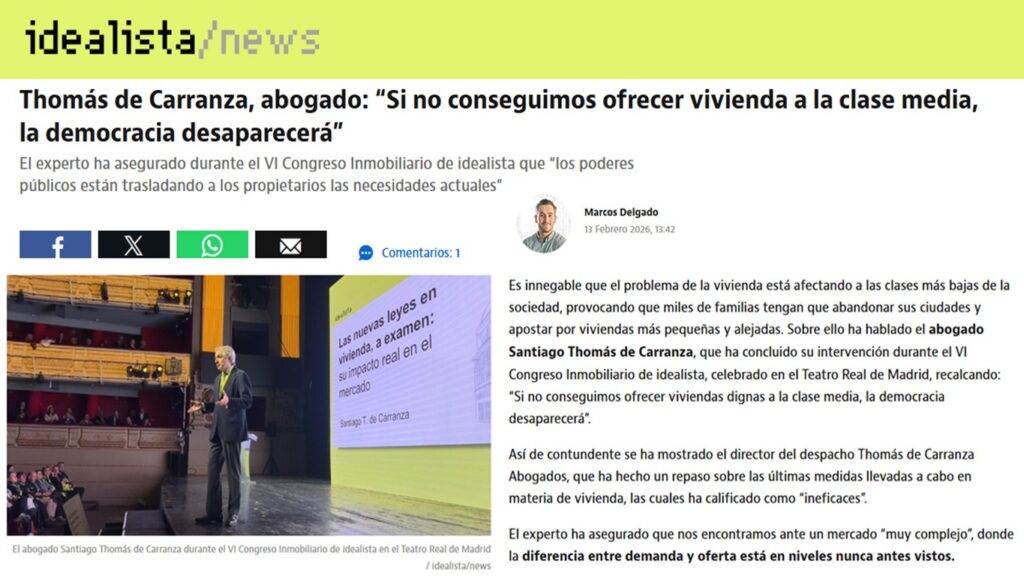
Santiago Thomás de Carranza, managing partner of the law firm that bears his name and a specialist in real estate law, analyzes in Idealista News the scope of the housing decrees approved by the government and their implications for property owners. In his view, “the measures introduce new restrictions that could exacerbate legal uncertainty and reduce the supply of rental housing, without resolving the structural problem of access to housing.”
Among the provisions analyzed are the extraordinary extension of up to two years for certain residential lease agreements, as well as limits on rent increases and expanded obligations for landlords. The expert warns that these measures“must be analyzed not only for their immediate effects on landlords and tenants, but also for their potential impact on the decisions of those who offer housing for rent.”
One of the issues it raises is the automatic extension of five or seven years provided for in one of the decrees, depending on whether the landlord is an individual or a legal entity. The regulation allows the landlord to object under certain conditions, but it provides for compensation to the tenant of up to twelve months’ rent. For the attorney, this provision is“nonsense” that could cause prices to rise immediately and reduce the supply of rental units if it ultimately goes into effect.
However, Thomás de Carranza distinguishes between the two royal decrees approved by the government. While the one providing for an extraordinary two-year extension and other measures has already taken effect, the one including automatic extensions of five or seven years is pending ratification and, as he points out in the interview, does not have the necessary support to move forward.
More Uncertainty for Homeowners
During a conversation with Idealista News, the head of the law firm that provides legal management for 16,000 properties throughout Spain also addressed the cap on annual rent increases—set at 2% in certain cases and valid through December 31, 2027— as well as the changes affecting seasonal leases. Regarding the latter, the attorney emphasizes that these leases will now be subject to the legal framework governing residential rentals, with the requirement to provide evidence justifying their temporary nature.
Santiago Thomás de Carranza emphasizes that the burden of proving this temporary nature rests with the landlord. Therefore, “it is not enough to simply include that designation in the lease: there must be a valid reason justifying the temporary nature of the lease. If this is not proven, the lease may be considered a primary residence lease, with the resulting implications regarding duration and renewals.”
The attorney also questions the extension of the eviction moratorium through December 31, 2030, and its effects on landlords, including those who own only one rental property. In his view, these measures as a whole “increase regulatory complexity and uncertainty when deciding whether to rent out a property and under what conditions.”
Another important aspect related to disputes addressed by the new regulations concerns the payment for minor repairs. According to the head of the law firm Thomas de Carranza Abogados, until now, minor damage resulting from normal wear and tear was the tenant’s responsibility; now, the landlord will be responsible for it. “ That’s going to lead to absolutely wild conflict. Does it make sense that, for example, a faucet handle—a 3-euro part that has broken due to normal wear and tear caused by the tenant’s use—should be replaced and paid for by the landlord? In my opinion, no.”
Full interview: https://www.idealista.com/news/inmobiliario/vivienda/2026/10/13/918359-what-changes-for-landlords-with-the-decrees-extensions-and-rent-caps-of-2